Showing posts with label Berkeley Telephone poles. Show all posts

Tuesday

A leap of faith


Since I finished the painting “White on White”—my last post—more than a month ago, I felt I had only scratched the surface when it came to interpreting Typography Graveyard, a collection of photographs taken over a period of more than five years of the Berkeley telephone poles and the remains of fliers and posters.


Unfinished and in progress, stage 3
8 x 8” inch (20.32 x 20.32 cm) Shopping bags for a base, treated and
sculpted Bristol paper on canvas


So after taking a leap of faith these last weeks, I have set out upon a journey with the idea of creating a collection of paintings that would take my visual interpretation from a photograph to another level and with no less than thirty-five canvases. A huge undertaking even if these canvases are only 5 x 5” inches (12.7 x 12.7 cm), with an additional undisclosed number that are 8 x 8” inch (20.32 x 20.32 cm).


Unfinished and in progress, stage 3
5 x 5” inch (12.7 x 12.7 cm) treated and sculpted Bristol paper on canvas then covered with gesso,
 further adjustments made after adding new pieces of treated Bristol paper


Unfinished and in progress, stage 3
5 x 5” inch (12.7 x 12.7 cm) treated and sculpted Bristol paper on canvas


This undertaking of mine is now in its third week and during this time many technical discovers have been made as I experiment with different kinds of archival art papers, including vintage book pages, something I thought I would never do, since I love books too much to actually be cutting one up. Once the first cut was made, the next several were easier and now I not only have vintage book pages, but also plenty of interesting binding material and fibers for use in another project, with a few ideas already percolating in the back of my mind.
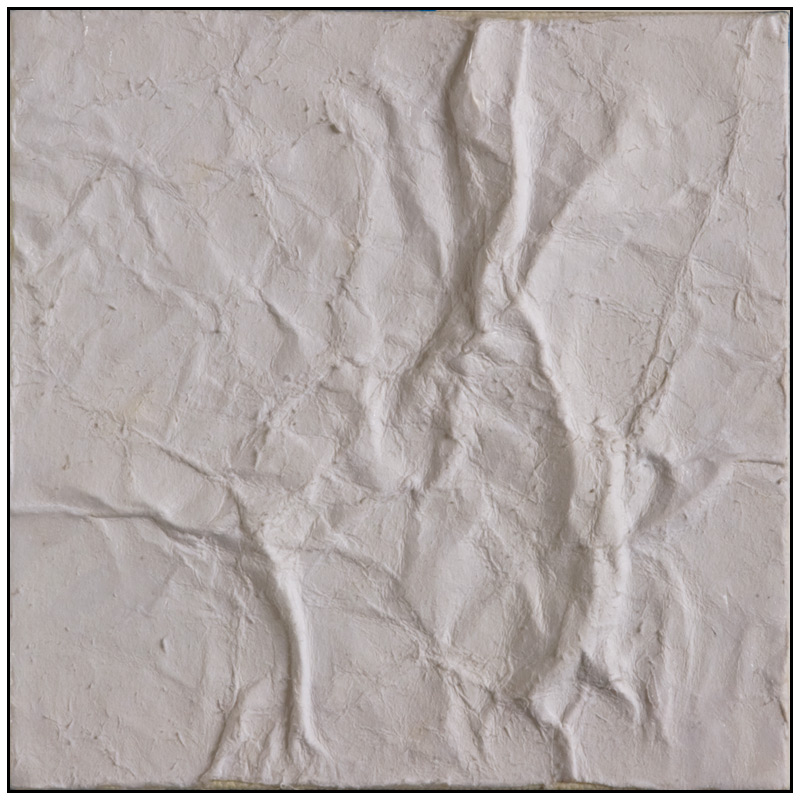


Unfinished and in progress, stage 1
5 x 5” inch (12.7 x 12.7 cm) treated Bristol paper on canvas


With each new canvas that is started I take another leap of faith in how I use the materials so that there are plenty of differences and yet enough similarities from one canvas to the next, including going back to those I first considered finished and ready for their last two stages, making further adjustments. 


With the first twelve canvases ready for their last two stages, I have opted to first build the foundation to which all layers are added, this way I can maintain control over quality and the look of the series, which otherwise could be jeopardized. This most likely will take two weeks with an additional three to six weeks for building the layers that will represent the Typography Graveyard, with an equal amount for painting the layers in acrylic and then finishing the painting in oil.


Unfinished and in progress, stage 1
5 x 5” inch (12.7 x 12.7 cm) treated charcoal paper on canvas


This will be only the second time in which I have set out to do a series, the other time was in 2000 and took eighteen months, over seven hundred sketches to complete 8 (?) 36 x 36” inch paintings based on Russian Reconstructivism and German Bauhaus.


Unfinished and in progress, stage 1
5 x 5” inch (12.7 x 12.7 cm) various art papers and vintage book text on canvas


Unfinished and in progress, stage 1
5 x 5” inch (12.7 x 12.7 cm) various art papers and vintage book text on canvas


So please join me over the next couple of months as I will sharing more photographs documenting the progress of these small paintings from the layering stages throughout the painting phase.


Thank you for your visit
and comment . . .
Egmont

Saturday

The making of “White on White”


A little over two weeks ago I pulled a canvas from storage and started my first painting in twenty-one months. My inspiration came from the Berkeley telephone poles I had been covering for more than five years in a series named “Typography Graveyard.”


The canvas was first covered with grocery shopping bag paper because of its strength, secured with medium gel, then a second layer of paper was applied. This application served to recreate the three-dimensional shapes that were captured in my photographs. Afterwards when the entire area was given another application of medium gel before everything was covered with gesso, including the underside of the exposed paper forms.


Now with the canvas surface prepared and ready for paint, the area was painted with three different shades of white acrylic paint, followed by one more application of acrylic colours so that I had the colourations I was after. A few days later it would receive a layer of oil paint, mixed with a high percentage of Winsor & Newton’s Liquin; this would function as a glaze and allow some of the acrylic painting to blend through, for a richer but still subtle colour range.


One of the features in this painting is how changing light within room affect the paintings surface. The many shadows that seem to come to life and chance the paintings appearance throughout the day. It is this added—not noticeable at first—nuance that turns a minimalistic painting into a contradiction of riches.


Stage one: covering the canvas with a layer of paper


Stage one: completed


Stage two, partial completion of the texture layer


Stage two: completed


Stage two: completed


Stage three: application of gesso


Stage three: me applying the gesso


Stage three: completed


Stage three: completed application of gesso


Stage four and five: completed application of two layers of acrylic paint.
What follows is stage six: a glazing with oil paints.


“White on White”
MM-O/C 36x48” (91.44 x 121.92 cm) 


Thank you for your visit
and comment . . .

Egmont


A leave of absence


In the last two months I have fallen considerable behind on many levels, this includes responding to those who have commented and especially my visiting your blogs with any regularity.
Many of you also know of my medical challenges that have been a major distraction, particularly the previous month learning after an angiogram that the reason for always feeling tired and short of breath was due to a collapsed graft from the open heart surgery three years earlier.
Since some of the lateral veins to the artery have tried to take over, the current method of dealing with this is through medication and a three-day a week’s cardiac rehabilitation program that will last for three months,
Because this program occupies a large portion of my day, I would only fall further behind and so I have no option other than to take a leave of absence while I am in cardio rehabilitation.
This does not mean I will not be looking in now and then on your blogs, just that I shall not be posting. The decision was not taken lightly as I have worked hard these passed months building my blogs.


Typography of the forgotten - series


As the medical center is in Berkeley, I will have the opportunity to continue a series on telephone poles that I have been observing and photographing these passed four years. Their abstract appearance has intrigued me, even influenced some of my paintings, and now I have a chance to capture with greater frequency and regularity their continued temporary change and evolution.


I look forward to my return in August, sharing with you stories and images I have been working on.


Thank you for your visit

Egmont
