Showing posts with label Abstract Realism. Show all posts

Tuesday

A leap of faith


Since I finished the painting “White on White”—my last post—more than a month ago, I felt I had only scratched the surface when it came to interpreting Typography Graveyard, a collection of photographs taken over a period of more than five years of the Berkeley telephone poles and the remains of fliers and posters.


Unfinished and in progress, stage 3
8 x 8” inch (20.32 x 20.32 cm) Shopping bags for a base, treated and
sculpted Bristol paper on canvas


So after taking a leap of faith these last weeks, I have set out upon a journey with the idea of creating a collection of paintings that would take my visual interpretation from a photograph to another level and with no less than thirty-five canvases. A huge undertaking even if these canvases are only 5 x 5” inches (12.7 x 12.7 cm), with an additional undisclosed number that are 8 x 8” inch (20.32 x 20.32 cm).


Unfinished and in progress, stage 3
5 x 5” inch (12.7 x 12.7 cm) treated and sculpted Bristol paper on canvas then covered with gesso,
 further adjustments made after adding new pieces of treated Bristol paper


Unfinished and in progress, stage 3
5 x 5” inch (12.7 x 12.7 cm) treated and sculpted Bristol paper on canvas


This undertaking of mine is now in its third week and during this time many technical discovers have been made as I experiment with different kinds of archival art papers, including vintage book pages, something I thought I would never do, since I love books too much to actually be cutting one up. Once the first cut was made, the next several were easier and now I not only have vintage book pages, but also plenty of interesting binding material and fibers for use in another project, with a few ideas already percolating in the back of my mind.
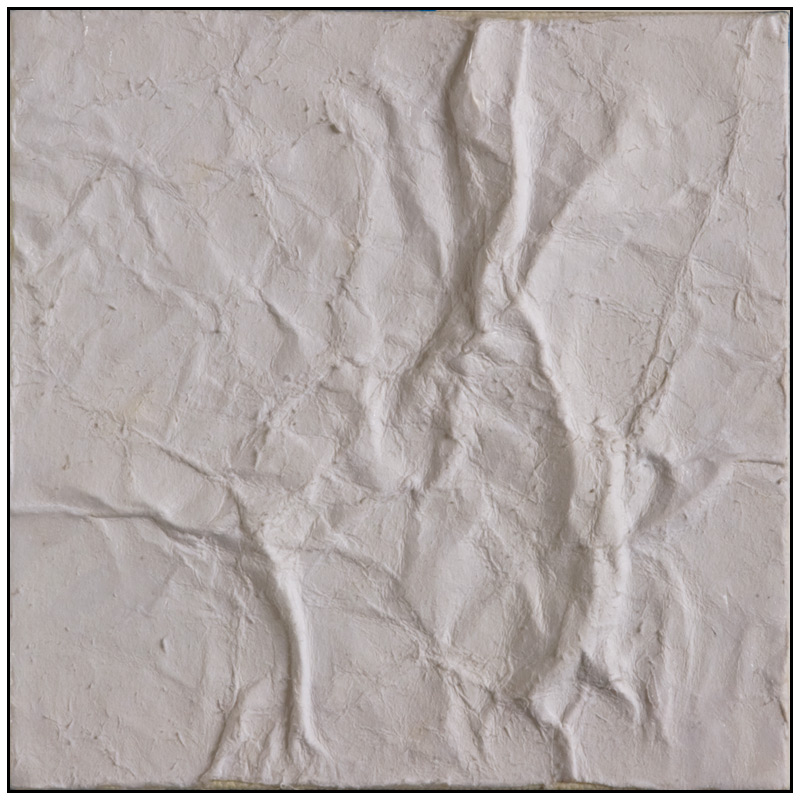


Unfinished and in progress, stage 1
5 x 5” inch (12.7 x 12.7 cm) treated Bristol paper on canvas


With each new canvas that is started I take another leap of faith in how I use the materials so that there are plenty of differences and yet enough similarities from one canvas to the next, including going back to those I first considered finished and ready for their last two stages, making further adjustments. 


With the first twelve canvases ready for their last two stages, I have opted to first build the foundation to which all layers are added, this way I can maintain control over quality and the look of the series, which otherwise could be jeopardized. This most likely will take two weeks with an additional three to six weeks for building the layers that will represent the Typography Graveyard, with an equal amount for painting the layers in acrylic and then finishing the painting in oil.


Unfinished and in progress, stage 1
5 x 5” inch (12.7 x 12.7 cm) treated charcoal paper on canvas


This will be only the second time in which I have set out to do a series, the other time was in 2000 and took eighteen months, over seven hundred sketches to complete 8 (?) 36 x 36” inch paintings based on Russian Reconstructivism and German Bauhaus.


Unfinished and in progress, stage 1
5 x 5” inch (12.7 x 12.7 cm) various art papers and vintage book text on canvas


Unfinished and in progress, stage 1
5 x 5” inch (12.7 x 12.7 cm) various art papers and vintage book text on canvas


So please join me over the next couple of months as I will sharing more photographs documenting the progress of these small paintings from the layering stages throughout the painting phase.


Thank you for your visit
and comment . . .
Egmont

Saturday

The making of “White on White”


A little over two weeks ago I pulled a canvas from storage and started my first painting in twenty-one months. My inspiration came from the Berkeley telephone poles I had been covering for more than five years in a series named “Typography Graveyard.”


The canvas was first covered with grocery shopping bag paper because of its strength, secured with medium gel, then a second layer of paper was applied. This application served to recreate the three-dimensional shapes that were captured in my photographs. Afterwards when the entire area was given another application of medium gel before everything was covered with gesso, including the underside of the exposed paper forms.


Now with the canvas surface prepared and ready for paint, the area was painted with three different shades of white acrylic paint, followed by one more application of acrylic colours so that I had the colourations I was after. A few days later it would receive a layer of oil paint, mixed with a high percentage of Winsor & Newton’s Liquin; this would function as a glaze and allow some of the acrylic painting to blend through, for a richer but still subtle colour range.


One of the features in this painting is how changing light within room affect the paintings surface. The many shadows that seem to come to life and chance the paintings appearance throughout the day. It is this added—not noticeable at first—nuance that turns a minimalistic painting into a contradiction of riches.


Stage one: covering the canvas with a layer of paper


Stage one: completed


Stage two, partial completion of the texture layer


Stage two: completed


Stage two: completed


Stage three: application of gesso


Stage three: me applying the gesso


Stage three: completed


Stage three: completed application of gesso


Stage four and five: completed application of two layers of acrylic paint.
What follows is stage six: a glazing with oil paints.


“White on White”
MM-O/C 36x48” (91.44 x 121.92 cm) 


Thank you for your visit
and comment . . .

Egmont


I am finally painting again


Earlier this month we had record high temperatures as if it were mid-August, now it has been raining most of the week and by tomorrow the temperatures are to drop so low that if the rain continues, we are expecting the possible of snow in the lower elevations. The last time the Bay Area had any snow was in 1976, however I was in Europe at the time and therefore have no recollection of the event. 


Right now I welcome the rain as there is nothing better to do than to paint, continuing the work I started about a week ago on my first painting in more than a year ago. in the meantime I look forward to the possibility of a little snow.


After applying the sculptured material to the canvas, it was time to prepare the entire surface for painting by applying gesso. Doing so with a brush which which I will be painting in Acrylic and then using oils, helps me to contact mow directly with the surface and get a feel for the type of brush work I will need to apply for the desired effect.


It will be at least another two weeks before I may consider the painting finished, in part because white always takes longer to dry and the weather is not helping in that department. Besides, the process of painting needs to evolve, were the artist connects with the painting and vise versa. 


Upon the completion of the painting I will share with you the entire evolution and process, along with plenty of photographs that have documented the process through the various stages. So stay tuned.


Thank you for your visit and comment,
Egmont


A leave of absence


In the last two months I have fallen considerable behind on many levels, this includes responding to those who have commented and especially my visiting your blogs with any regularity.
Many of you also know of my medical challenges that have been a major distraction, particularly the previous month learning after an angiogram that the reason for always feeling tired and short of breath was due to a collapsed graft from the open heart surgery three years earlier.
Since some of the lateral veins to the artery have tried to take over, the current method of dealing with this is through medication and a three-day a week’s cardiac rehabilitation program that will last for three months,
Because this program occupies a large portion of my day, I would only fall further behind and so I have no option other than to take a leave of absence while I am in cardio rehabilitation.
This does not mean I will not be looking in now and then on your blogs, just that I shall not be posting. The decision was not taken lightly as I have worked hard these passed months building my blogs.


Typography of the forgotten - series


As the medical center is in Berkeley, I will have the opportunity to continue a series on telephone poles that I have been observing and photographing these passed four years. Their abstract appearance has intrigued me, even influenced some of my paintings, and now I have a chance to capture with greater frequency and regularity their continued temporary change and evolution.


I look forward to my return in August, sharing with you stories and images I have been working on.


Thank you for your visit

Egmont


Monday

Stalemate comes to an end

With Industrial Wall, version #2 painting completed and version #1 a week earlier, I was itching to start another painting but then there was one leaning against the family living room wall that I had hoped to have completed by now, especially this last weekend since the painting is of the American flag and this nation just had celebrated Fourth of July.


For more than a year I thought of doing a series of paintings involving the American flag and what it had become to represent under the former Bushes Administration. Great thought was taken as to the idea of defacing the American flag, for that matter, any sovereign nations flag and how one might feel about. The idea of adding paint, various acrylic mediums, an oil glaze, and eventually text from the American Constitution or other text was all carefully analyze, along with my own personal feelings about America, my host country.


Over time the project began to visually materialize, then in January of this year I had that creative itch which remained persistent over a number of days. Without much planning I proceeded to paint, only to find myself later in a long stalemate that has lasted almost five months.


A number of solutions were contemplated during those months and I even came close to implementing one, but every time I proceeded to try and leave a mark, that long awaited change, I stopped. Though frustrated with myself, I promised myself this painting would not be abandoned!


Sometimes a spontaneous attempt towards a blank canvas can work. In the beginning this painting had everything going for it until I realized that if wanted to add handwritten text, portions of a shredded copy of the American Constitution, and possible some anti war graffiti, the sequence I had so far undertaken, now had a few wrinkles.


This holiday weekend provided a breakthrough, as I took on the attitude of ‘What have I to lose?’ when the first pencil marks were laid the words ‘defending democracy, defending identity’, progress was finally being made and more words were now being written on the painting.


Though there were numerous interruptions this Sunday, work on the painting slowly continued, carefully selecting an area where to leave a word, a thought, or a sentence and though considerable progress had been made, the painting still remained unfinished. Only now did I begin to see that with a few more words or couple of lines the painting would not only be completed, it would reflect the feeling I had so long wished to express.

Saturday

The industrial wall – part two

One never knows how a painting is going to turn out until it has been completed, especially when it is of an abstract genre and painted over a period of weeks.
No matter how much careful planning one does, there is always the unknown or the voice of intuition that changes the direction of what was originally intended. Of course there is also the unintentional accident that can have a major influence in the direction that one is heading, including the final outcome of the paintings appearance. Another element one must to take into account is the fear of failure for it is a powerful distraction, even with my previous found confidence in which I succeeded in accomplishing what was mentally envisioned.


What I have learned technically from this painting can now be apply towards the next one, with the understanding there are no guarantees that the results will be as before. Painting is not a formula of steps with predictable results and in many ways this makes multi-medium painting a challenge as well as an exciting undertaking.
Each abstract painting I ever painted had its unique challenges and Industrial Wall — Flint Ink, version two, certainly was no different. Mixing a variety of acrylic products in order to achieve certain textures was new territory. When working as a multi-medium artist, I feel like an alchemist of the Middle Ages trying to turn iron into gold and in many ways today’s multi-medium processes are no different from when artists had to grind their own colours.

As the painting Industrial Wall — Flint Ink passed the half way mark, I took a chance of using a household spray paint containing a foreign element that gave it a fine raised surface texture. I was very apprehensive using this product but after spraying a single burst on the canvas, I was delighted, for it had provided the very thing I desired but had not attained until that moment.
The next step was to make sure to apply the spray sparsely and give it the unintentional accident look that gives it the appearance I saw the day I visited the Flint Ink plant. Because of that one burst from a spray can, the painting had taken another turn, allowing further applications of acrylic materials for a greater depth of texture and detail.
Last Wednesday the painting was finished off with a three layers Manganese Blue Nova colour with Liquin glaze, with the last two glazes being only over portions of the painting so that it resembles an external light source.


Industrial Wall — Flint Ink, version #2
Multi-medium combine on canvas, 36 x 48 inch (91.44 x 121.92 cm)

Yesterday I added the final touches, the shipping label, as it was previously tucked in under the wood temporarily and since it was rather fragile, an index card was added to the back with an additional layer of extra heavy gel medium for support and giving it a slight curvature in a permanent hold. The original nail was returned to its previous location and some twine saved from a package was secured to it along with a Sharpie pen.

In the end the painting came into its own, different from the photograph it was based upon, even though numerous elements in its makeup are also found in the photograph, the canvas underwent several evolutions to arrive at its final state. A little planned, a dash of the unexpected, a pinch of the unintentional accident, a twist of fear, and a good dosage of trust in ones own vision and ability.

In the end you have to trust in yourself, your ability and your intuition.


Tuesday

Fear of failure despite a new found confidence

Revisiting the past is a melancholy affair. A journey taken not lightly for it can be filled with a gambit of emotions, as I look over a number of photographs taken in 2005. Images reflecting a time when I hiked the hills behind our house. Exploring the early morning light as it filtered through the California oak trees, gracing the spring growth with its pale amber light, these photographs marked a time in my life that will not be repeated soon, since the focus has shifted to painting.


The last several days I have meant to write and update the progress of the Abstract Realism painting ‘Industrial Wall — Flint Ink’, considering significant progress had been made, not only with version two, featured earlier this month on this blog, but version one was completed this last Sunday.


Both versions are based on the same photograph with key differences between the two. I had planned early on the idea of two versions, considering both paintings were going to be an experiment in regards to the combinations of materials used, one painting (version #1) will be offered for sale and version two with the ‘combine’ materials would be part of the van Dyck Trust collection.


So this weekend the final touches, an oil-based glaze with Liquin was applied over the entire canvas, with a second coat within in the hour, only over portions of the canvas so that there would be the illusion of different light sources.


A third coat using the same percentages of Liquin to Manganese Blue Nova oil paint was once again applied to only portions of the canvas in order to strengthen specific areas and the following day under cool early morning light the decision was made that this painting was finished. Now I am faced with the decision if this glaze application should also be added to the other canvas, especially since I had planned it in the first place.


The decision came quickly when I accidentally came across the finished painting in perfect light and saw that the intent was captured after all. So once I have photographed version two in its present stage, I can move ahead and bring another painting to completion.


Though I have found success with one painting, there is still the lingering fear of failure until the other painting has the same outcome and when I manage to have a satisfactory result, I will have learned from the process but fear of failure remains strong despite my newfound confidence.


As we bring another month to a close like a chapter in a book, we begin anew another, like the path before us, one often traveled but never the same twice, I will seek inspiration in familiar places, all the while discovering new ones.

Thursday

The industrial wall - part one

Before my semester of Modern and Contemporary Art History class came to an end at Diablo Valley College, Professor Michael Lawrence, our instructor had ask me a month earlier if I wanted to give a presentation regarding my art. I felt this would be a good first run considering a few months later I am scheduled to give a presentation to the members and guests of the East Bay Artists Guild.
Deciding to focus on photography, specifically my abstract images and how I go about seeking my subject matter.


Back home I combed through some twenty-five thousand images, when I came across one taken at an industrial site that had shut down and at that time the building underwent an environmental cleanup.


Having entered through the back entrance unseen, I had managed to set up my tripod, capture a dozen or so images inside before being discovered and having to leave the premises. Now four years later, one of these images from the Flint Ink plant I selected for the lecture captured my imagination; especially since just a week earlier I coined the term Abstract Realism in regards to my work.

Impulse got the better of me and during the preparations for the class presentation I just had to start the painting by giving it first several applications of gesso, this was followed with three layers of silver foil and a coat of sealer.


Several weeks would pass before any progress on the painting would continue as I had to work out numerous technical challenges, especially as I was entering new unexplored territories as to the materials I had not used previously, especially when one considers my goal was to recreate a photograph onto a 36 x 48 inch (91.44 x 121.92 cm) canvas.


Though I had previously used found objects or textured materials in a painting, I was now embarking on using commercially produced acrylic texture materials to visually establish the richness that took years to build up through accident or on purpose.

After lengthy contemplation the decisive moment arrived or the painting would remain unfinished and so the first layers of texture was applied to the canvas. Since then the painting has progressed through numerous changes but remains still unfinished, requiring a final coat or two of a glaze using oil paint mixed with Liquin to give the illusion of a light source striking the industrial wall.


Each step undertaken was a calculated experiment, though still a risk and any wrong move would alter the painting into something other than intended and at worst ruin what each step has achieved.


Fear is an element we all face in varying degrees and in the creation of art it can be very destructive, keeping us from not only achieving our potential but also from producing a work of significant importance in the growth as artist. Yet fear can also be a positive thing, by keeping any over confidence in check, since too much self-confidence can be just as destructive as fear.


With the painting a little more than half completed I tried out the shipping label, loosely nudging it between canvas and the piece of wood in order to see how it looked.


When I originally discovered the label I just fell in love with its imperfect quality and since the painting needed some bright snappy colour and a focal point to draw attention to the hand written notes still to be added.


This painting has taken six weeks to get to were it is at now and it might take another fourteen days before this canvas can be considered a finished painting.

To be continued . . .
